

Your Vow is Personal.
Your Marriage License is Legal.
For generations, you’ve been told that getting a government marriage license is simply part of getting married. But have you ever stopped to ask why? Have you ever been encouraged to understand the legal, financial, and governmental authority that may come with signing it?
This isn’t about telling you not to commit or not to marry. It’s about making sure you choose with clarity.
My Vow. My Way. invites you to ask the questions most people never think to ask until it’s too late. Why is a government marriage license considered necessary? What legal rights and responsibilities do you take on when you sign it? Are there alternatives? And who benefits from a system that so few people fully understand before they say, “I do”?
Inside the book, you’ll explore these questions through research, history, and real-world consequences. You’ll be challenged to examine long-held assumptions, think independently, and make one of life’s most important decisions with knowledge—not just tradition.
Start the conversation. Read the book. Ask the questions. Then decide your own way.
My Vow. My Way.
This book is not anti-love, anti-family, or anti-commitment. It is about informed choice. It encourages couples to ask deeper questions before legally marrying, to understand the risks of entering a government-regulated contract, and to consider whether personal commitment can be honored privately, spiritually, emotionally, and practically without surrendering control to the state.
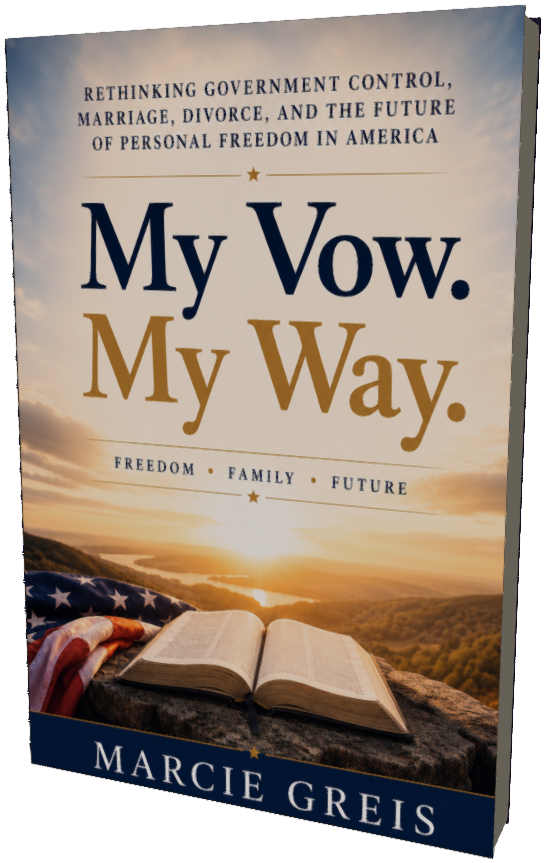
Who is this book really for?
- This book is for every person standing at the edge of one of the most important decisions of their life.
- It is for the young couple discussing engagement.
- It is for the woman who has dreamed of marriage since childhood.
- It is for the man preparing to ask someone to spend the rest of their life with him.
- It is for parents who want their sons and daughters to make informed decisions.
- It is for couples planning a wedding who have spent months discussing flowers, venues, rings, photography, and guest lists—but have never once discussed the legal contract that follows.
- It is for people who believe commitment deserves more preparation than a single ceremony.
- It is for those who understand that love and responsibility are not opposites.
- It is for those willing to ask questions that society rarely encourages.
- This book is for people who want to understand the difference between love, commitment, tradition, and legal obligation before those distinctions become life-changing realities.
- It is for individuals who believe informed consent should apply to every major decision in life—including marriage.
- It is for future husbands.
- It is for future wives.
- It is for future parents.
- It is for future generations.
- Most importantly, it is for people who refuse to blindly sign and retain a state marriage license —financial, professional, medical, or legal—without first understanding what they are agreeing to.
- For decades, society has encouraged people to prepare for the wedding day.
- My Vow. My Way. encourages people to prepare for the marriage itself.
- Not out of fear.
- Not out of cynicism.
- Not because commitment is something to avoid. It’s to question who you’re allowing to control if the Marraige breaks down.
- But because commitment is something so important that it deserves complete honesty, complete transparency, and complete understanding before a single signature is placed on a government document.
Why do we teach people how to plan weddings but not how to evaluate marriage?
- From a young age, society teaches us how to prepare for a wedding.
- We discuss the dress.
- The venue.
- The flowers.
- The rings.
- The photographs.
- The honeymoon.
- The guest list.
- The menu.
- The music.
- The decorations.
- The perfect day.
- Entire industries worth billions of dollars exist to help people prepare for a wedding.
- But where is the education surrounding the legal contract that follows?
- Why are so few people encouraged to understand the laws they are agreeing to?
- Why are so few people encouraged to ask difficult questions before signing?
- Why don’t we discuss the “what if” scenarios?
- What if one spouse becomes financially irresponsible?
- What if one spouse builds a successful business?
- What if one spouse inherits money?
- What if one spouse stops working?
- What if one spouse wants to leave?
- What if children are involved?
- What if priorities change?
- What if promises are broken?
- What if the relationship simply doesn’t survive?
- Why are these questions often considered uncomfortable before marriage but unavoidable afterward?
- Why do we encourage people to prepare for the celebration but not prepare for the consequences?
- Why do so many people enter one of the most significant legal agreements of their lives without fully understanding how it works?
- Why are we told to focus on trust, but discouraged from discussing risk with a state Marraige license?
- Why are we encouraged to talk about centerpieces but not asset division by the state which now controls your future by retaining a state Marraige licence.
- Why are we encouraged to discuss seating charts but not financial exposure?
- Why are we encouraged to choose a honeymoon destination but not understand the legal process that may govern the relationship for decades?
- And perhaps the most uncomfortable question of all:
- Who is really in control once the contract is signed?
- Do couples remain fully in control of their relationship?
- Or does authority gradually shift to courts, statutes, procedures, attorneys, judges, and systems that were never part of the wedding vows?
- Why do so many people discover the true power of those systems only when a relationship begins to fail?
- Why do so many families spend years and sometimes fortunes navigating legal processes they never anticipated?
- Why are legal fees capable of consuming savings, retirement accounts, home equity, inheritances, businesses, and opportunities that took decades to build?
- Why has society largely accepted this as normal?
- Why do we rarely question a system where the breakdown of a personal relationship can trigger years of litigation, enormous financial expense, and profound emotional consequences?
- Why is asking these questions often viewed as controversial?
- Shouldn’t every major institution be open to examination?
- Shouldn’t every contract be understood before it is signed?
- Shouldn’t informed consent matter?
- My Vow. My Way. does not tell readers what conclusion to reach.
- Instead, it asks a question that society rarely encourages:
- If this decision has the power to affect your finances, your family, your future, your property, your children, your retirement, and your freedom, why aren’t we having these conversations before people say “I do”?
- Perhaps the real issue is not marriage itself.
- Perhaps the real issue is that too many people enter it without ever being encouraged to ask the questions that matter most.
FAQs
What is the meaning of My Vow. My Way?
My Vow. My Way. means that commitment should begin with personal choice, informed consent, and mutual understanding. It reflects the belief that two people should be able to define their promises, responsibilities, values, and future together without automatically placing their private relationship under government control.
I’ve had a painful divorce. How can this website help me?
This website is designed to give people language, perspective, and community around experiences that are often painful, isolating, and misunderstood. It does not provide legal advice, but it helps readers think critically about marriage, divorce, family law, and the systems that can financially and emotionally impact families.
Are there better approaches to marriage and relationship commitment?
Yes. The book encourages couples to discuss finances, property, expectations, children, faith, family roles, conflict, and long-term responsibilities before making legal commitments. For some couples, traditional marriage may still be the right choice. For others, private vows, legal agreements, financial planning, or alternative commitment structures may offer more clarity and protection.
What is marriage good for, and is it right for me?
Marriage can provide emotional, cultural, religious, legal, and family meaning for many people. The question is not whether marriage is good or bad. The question is whether each person fully understands what they are entering. My Vow. My Way. encourages readers to slow down, ask hard questions, and make informed decisions before signing a legal contract.
Sign me up for news and updates:
How divorce became one of the most expensive breakups in America
Lorem ipsum dolor sit amet, consectetur adipiscing elit. Integer nec odio. Praesent libero. Sed cursus ante dapibus diam. Sed nisi. Nulla quis sem at nibh elementum imperdiet. Duis sagittis ipsum. Praesent mauris. Fusce nec tellus sed augue semper porta. Mauris massa. Vestibulum lacinia arcu eget nulla. more »
Why love should not require blind legal risk
Nulla metus metus, ullamcorper vel, tincidunt sed, euismod in, nibh. Quisque volutpat condimentum velit. Class aptent taciti sociosqu ad litora torquent per conubia nostra, per inceptos himenaeos. Nam nec ante. Sed lacinia, urna non tincidunt mattis, tortor neque adipiscing diam, a cursus ipsum ante quis turpis. Nulla facilisi. Ut fringilla. Suspendisse potenti. Nunc feugiat mi a tellus consequat imperdiet. Vestibulum sapien. Proin quam. Etiam ultrices. more »